

1:3. Amber Scorched with Honey.
In which the courtship deepens through politics, poetry, and sightseeing drives—until Great-Aunt Mary drops a cannonball on the drawing-room rug.

A LIFE BEFORE The Story So Far: It is 1887 in the French spa town of Royat, where the beautiful, wealthy, and bereaved Maud Gonne has been brought to convalesce after the death of her beloved father. There, unmoored by grief, she has met the elegant Boulangist politician, Lucien Millevoye, and life looks like it might be worth living, after all. SCROLL DOWN TO READ ON
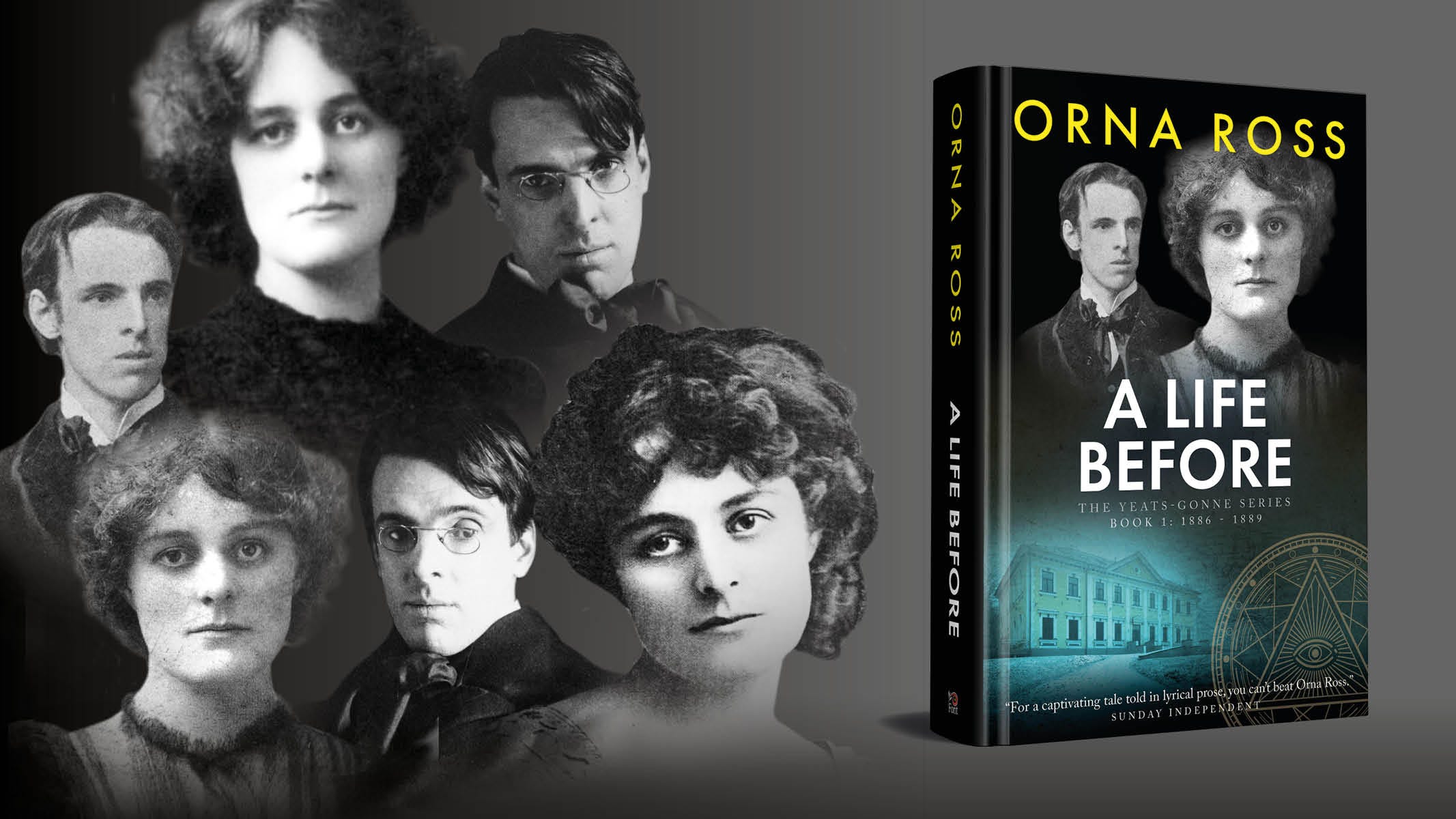
A Life Before is a literary-historical novel, based on the true life story of the English heiress turned Irish revolutionary, Maud Gonne, and the poet she inspired, W.B.Yeats. A story of passion, intrigue, and spiritual ambition set in 1880s Ireland, England and France, it is narrated by Rosy Cross, ‘the oldest woman in Ireland’. Each episode forms a standalone short story that, taken together, build to a whole.
The 3rd story is below. Begin at the beginning with Story 1: A Strange House of Time or find your place with The Story Index
Previous Story <— | Story Index |
NOW READ ON:
Amber Scorched with Honey
From that day of first meeting Lucien Millevoye, the world set itself differently about Maud Gonne. Since her father’s death, restlessness had hummed in her like one of those new telegraph wires and now she was ripe for letting Millevoye’s resolute mind settle the direction of her own. She welcomed the new battalions of notions and sensations he set loose in her.
They were fortunate that Great-Aunt Mary treated chaperones as bishops treat mitres—in prominent display but mostly for show. Maud Gonne easily slipped through the wide gaps in her aunt’s oversight and drew in conspirators for the rest. Together with others, she and Millevoye wandered the gravel promenades, and shuffled cards at the Casino, but not enough to excite comment. Together alone, they took ‘sightseeing’ drives out of town.
He was just the sort of man she wanted beside her: a poet’s grandson, steeped in the fine arts. Quick with sword and pistol, gentle to animals, gallant to women. Above all, fierce in politics.
Just to think of the Chambre des Députés got him in a lather. It was no parliament at all, he said, just a shabby club of swinging-door ministries, the same weak men returned year after year, the same bribes passed under the table, the same big barrels of wine trundled to the polling booths to slosh the vote. France’s political system was broken. It should never have adopted Republicanism.
‘You are a monarchist?’
‘Non. In each age a nation must find its man of genius and pour itself into him. Royal families rarely produce such men. ’
Napoleon Bonaparte was his great hero—but alas a country rarely produces two such as him. The wise nation encouraged the best man it had and gave him leave to rule, with the people’s approval and a parliament of his picking. Despotism with bunting, and thank you kindly.
And Millevoye had chosen his despot de jour, the red-bearded Général Boulanger, who had already won the people—and Great Aunt Mary—with cavalry parades down the Champs-Élysées and giving them that fine drug of a wrong that must be righted so their country can be great again.
France had lost territory to the Germans fifteen years before and Boulanger, Millevoye insisted, was the man to win it back. ‘Retaliate! Reclaim! Revanche!’
Only Boulanger had proved himself, with his six woundings earned across the French campaigns in Indo-China and Algeria. Only he could bend the army into a force strong enough to meet France’s aims. Only he would dare instigate war, if war had to be dared.
‘And must it?’ Maud Gonne asked, alarmed.
‘We must hope not.’
They were sitting over a glass of red wine in the reading salon. The lamps were low on this side of the room and the steady glow from the fire grate belonged to them alone. Kathleen and their aunt were long abed while Rosa, that night’s chaperone, was playing a game of bridge with her party over by the window.
‘We must hope not but… a nation that relinquishes one inch of its territory is unworthy,’ Millevoye whispered. ‘Decadent, until it is regained. The greatness of France now depends on its willingness to recognise Général Boulanger.’
He told her about Boulanger’s recent trip to America, where he had refused to set foot on shore until the harbour hauled down its German flags. Just as you had your British, he had pointed out to the Bostonians, have we not our Prussians?
He told her how Boulanger had had every sentry box in Paris painted red, white and blue. And how he welcomed new recruits with ‘La Marseillaise.’ And how all this had hoisted him, at just forty-eight years, to the head of the Republic’s military, while simultaneously wooing those who were scheming to take the same Republic down.
‘It’s a daring game,’ Millevoye said, admiringly, ‘but recently he dared too much.’
Prime Minister Clemenceau had stripped him of his army post and banished him down here, to the big military camp at Clemont-Ferrand. Millevoye and other card-carrying Boulangists had followed in his wake, determined to see him win back his power, overcome the current government, and set him up as leader.
Millevoye gripped the carved curve of his armchair with passion. ‘Mademoiselle Gonne, do you afford us your support?’
To her young heart it all came twined together: the cause, the man before her, the promise of better. ‘Of course,’ she said.
‘Ah merci Mademoiselle. With you in our favour, we cannot fail. I feel certain now that we shall move the world as it needs to be moved.’
He bowed to her, as low and gallant as he could manage in the chair, and she laughed, as she always did, at his extravagant chivalry.
‘Your world, Monsieur, has moved many times before without my assistance. I daresay it will again.’
‘Ah non. Never as it will now, with you behind us.’
‘Behind you?’ She arched a brow. ‘Why, I cannot even stand behind my aunt without creating a scandal. You would not wish your reputation dragged back by mine.’
‘Such frivolity! Such cruelty. Here. Tenez. Feel here what you do to me.’
He reached across to take her hand and place it over his heart. Panicked, she darted a look across the room, but her friends were absorbed in their cards and nobody was paying them any heed. Beneath his waistcoat, his pulse thumped under her hand, and the longing she had felt on the stormy terrace, when he kissed her bare arm, leapt again. She looked into his eyes, then quickly away, startled by the glint of her own lust reflected back at her.
Maud Gonne had endured the full drilling of a nineteenth-century young lady: the press of powder and pins, the stretch of deportment and curtsy, the balancing of books on her head and patience on her tongue. Since that training, she had been polished in Parisian fashion by Aunt Mary, whose hobby was launching professional beauties. She had learned how to drop a word, place a pause, tilt a shoulder, flick a fan — so a man felt himself diminished, compelled to win back his lost inches by pleasing her.
Ever since the tomboy in her fell away and her beauty was named—first by her father, then by everyone after—she had used such tactics to keep men at bay. She had had to. Their hunger for her looks had been a constant scourge, one she had only played with and parried, but now her palm was warming to Millevoye’s pulse and the world was beating to a new beat.
* * *
He began to take her on drives beyond the town’s polite circuit, stopping where a hedge knitted tight, or the corn ran to a soft, golden high wall. They talked of everything and discovered a shared tenderness for animals, bristling together against the world’s indifference to the cruelty of vivisection.
Maud Gonne had come to that cause through pity; he dressed it in politics for her, as a symptom of the age’s sickness. The smoke from the factory chimneys, the soul scuffed thin by machines, the stink in every bargain with merchants and thieves, the filthy tide of modern life — this was the road that had brought him to Boulangism.
‘Such barbarism springs from a deeper sin, Mademoiselle — the worship of utility. The materialistic and mechanised mind of man stripping nature and humanity of the womanly virtues.’ His admiring smile travelled over the length of her. ‘The masculine intellect needs the feminine heart — beauty, mercy, sensibility — to right its moral scales.’
He read her Hugo and Musset and Baudelaire. She had been taught to love literature by her governess but Millevoye’s musical voice and intonation, and the pointed look in his eyes as he read, made her feel the nerve of each sentence.
Baudelaire was his favourite.
Whether you come from heaven or hell I do not care,
O Beauty, monster of splendour and terror, yet sweet at the core,
As long as your eye, your smile, your feet lay the infinite bare,
Unveiling a world of love that I never have known before!
‘You understand?’ he asked. ‘Nothing exists but beauty. The line of a body, of a statue, of a mountain — it is the same divine curve. Oh, perhaps it is wrong of me to expect a young lady to savour a poet of such subtile inspiration but I hope a day will come — oui, Mme Gonne — that you will feel these things as I feel them.’
When he gave her compliments, she only teased him. Flattery she could bat away with a smile, but when he sang his love-talk for France and her torn provinces, railed at the corrupt chamber, spat his contempt for parliament’s tinpot crises, she squirmed to his battle-cries. And noticed just how tall he was, and how elegant, with his high handsome forehead and the ends of his moustaches shaped to such a fine point, and his beautiful clothes so carefully assembled from the gleam on his boots to the soft precision of his cravat.
Day by day, his encroachments travelled a little further. A stray thread on a cuff found his lips moving off her glove to where skin began. A curl loosened by the wind was tucked back into place, his knuckles grazing the heat at her temple. The turning of a page together became a whole geography of her hand.
Each advance was granted but then she snipped the compliment, allowing the spark while scolding the flame. ‘Enough,’ she said, or ‘No, not yet,’ and she took herself home to her sister and aunt, fire banked within.
* * *
Then came the evening that had been marching towards them since they met, inevitable as rent day. Maud Gonne arrived home late, cheeks lit, hem dusty, the skin of her bare throat and shoulders alight, and found the lamps not doused as they ought to have been by that hour.
Sitting up in the drawing room was Great-Aunt Mary, a shawl about her shoulders, and a look-and-a-half upon her face.
‘So, you are home. Et où étiez-tu?’
‘At the Casino.’
‘And with whom?’
‘Rose and Lady Jane.’ The two friends who had agreed to back her, if asked.
‘Non!’ Great-Aunt Mary gave a small, lethal clap of her hands. She had it on authority: Maud Gonne had been seen, unchaperoned, with a gentleman. The Comtesse de Vichy had called that afternoon, and after fifteen minutes of twisting her pearls, told her friend what she’d come to say — how her carriage had halted on the road out of town to admire a tangled little wood when she spied a well-dressed couple sitting down on the grass. Sitting down! On the grass! Imagine her distress on recognising the girl for her dear friend’s great-niece.
Great-Aunt Mary had spent the evening—when she should have been enjoying the casino—making further enquiries. A bath-attendant had seen them by early morning in the winter garden. The porter had seen them by the lake. Royat had more eyes than trees and her niece had been giving all of them an eyeful.
Maud Gonne stayed quiet through her aunt’s disquisition but a feeling was catching and flaring in her—not shame, not guilt, but anger. Great-Aunt Mary, whose hobby was launching professional beauties, who had polished her up and paraded her around the promenades of Paris and Hamburg and Royat, who had done everything to get her a supper invitation from that old roué, the Prince of Wales, was suddenly climbing the high altar of virtue?
‘Don’t be cross, Aunt. Yes, I was with him.’
‘This Millevoye? How many times have I told you and your sister? You must not make yourselves a subject of talk for any man less than a marquis.’
‘M. Millevoye may not be a marquis but if you heard his—’
‘His what? Hot-air scribblings in a newspaper he does not own?’ Great-Aunt Mary flicked an invisible speck off her lap. ‘We have all read the thoughts of this scheming Number 2—or is it Number 10?—to Général Boulanger, and I can assure you, my dear, that—’
‘You are unjust. M. Millevoye is a man of true honour, a patriot who dearly loves France, and who—’
‘It’s all the same to me, ma chère, what this insignificant pen-pusher from Picardy loves. And all the same to you.’
Something in that ‘you’ made Maud Gonne take a half-step back even before Aunt Mary dropped her next annoucement like a cannonball on the drawing-room rug. ‘M. Millevoye is married. Married, with a son.’
A tight stillness, a cold spiral of truth, worked its way down over the hot denial that wanted to scream out. Maud Gonne allowed herself only one small blink.
‘So honourable he forgot to inform you, I see,’ Aunt Mary said, but the sight of her niece trying to swallow the news softened her starch.
‘Oh come now, don’t look so agonised.’ She patted the cushion beside her. ‘Come here, child. Sit.’
‘I prefer to stand, thank you.’
Maud Gonne’s body was holding itself upright by instinct.
‘Very well, then. Stand and listen to what you already know. I have launched more beauties than a shipyard has launched boats, and the stupid ones always move too quickly. You are not stupid, my dear. Or at least, I have always thought you are not?’
This was the second time Maud Gonne had had to endure that sentence from an adult. Tommy had used these selfsame words when she accepted a proposal from an unsuitable Italian the year before. Were they right? Was it stupid, to follow your heart, to allow your impulses? Why would God make Italian moonlight so affecting, and men like Millevoye so overpoweringly seductive, if one was not meant to succumb?
The comtesse was still discoursing. ‘The clever ones can mistake heat for altitude and, pouf! they melt away but the great ones, ah! The great ones turn desire into destiny. They choose the scandal that becomes legend, not gossip.’
‘And what of love?’
‘Oh love.’ Aunt Mary laughed a laugh light and sharp as a dressmaker’s pin.
Maud Gonne had a formidable chin and she raised it now. ‘I am not yet of age, Aunt, and I know I have much to learn but love is the one law I intend to obey in my life. I shall not be made ashamed of loving anyone.’
‘No, child. Be ashamed of squandering yourself.’ Aunt Mary gestured to the room around them: the silk damask catching the lamplight, the soft aubusson rug, the great gilt mirror and the velvet portières, the cellarage with its cut-crystal decanter, the spray of hothouse lilies laying out their expensive breath. ‘I have this life through care in choosing which men received my “love”.’
‘M. Millevoye may not have a title or a fortune, but he has a country. For that, he will fight to the last.’
‘And you?’
‘Me?’
‘I have trained you for greatness and you are not even playing clever. You are playing like a chorus-girl.’
This thought was even more shocking than the marriage announcement. Maud Gonne’s hand went to her throat, as if checking whether her voice was still there and lowered itself, too quickly, like she’d been caught touching something forbidden.
‘You speak of love,’ said aunt Mary. ‘Love is but a key. The question for a woman, chérie, is: which lock will it open? For a wife, love unlocks the law, the legacy, the lineage. For a mistress, it unlocks things a wife cannot risk. But for either, the man must be worth the opening. So now, I must insist. You will refuse to see this arriviste again.’
Maud Gonne swallowed, trying to send her feelings down into a safe, dark place until she was alone with time to examine them.
‘Oh my dear, do please sit. You are making me nervous, hovering like that.’
As Maud Gonne slowly lowered herself onto the chair, the comtesse rose with the air of one who has straightened a mess, crossed to the cellarage, took out two brandy glasses, and returned with two small cognacs.
‘À nos conditions,’ she said, pushing a glass across the low table towards her niece and raising her own.
‘And if I refuse?’ Maud Gonne asked.
‘We shall leave on the morrow.’
Maud Gonne recognised that sentence, as her aunt intended. It was what her father had said in Hamburg the year before, as he removed her from Great-Aunt Mary’s care, whisking her away to see Tristan und Isolde in Bayreuth. Awareness of Tommy, of the loss of him, entered the room, and with it that deathly draught his loss brought into every place he once warmed.
‘Chérie, remember what your dear, departed father prized. Courage, yes? But courage ça vaut le coup. When you walk into your first affair, you must walk in as his daughter.’
‘But these are your terms, Aunt, not Tommy’s.’
Maud Gonne knew that for the Colonel — as for Kathleen and her cousins and her friends — the rub would be the thing itself: any affair at all with a married man, Marquis or otherwise. Millevoye was a married man! Millevoye was a father! She needed to get away from her aunt to unravel the shock.
‘Your father would agree with me. If a gentleman cannot lift you, you are choosing to be lowered.’
She knew the words Tommy would actually have said if he were here — the same words he had said the summer before, when Aunt Mary had her near snared by the Prince of Wales in Hamburg; the same words he had said the summer before that, when she got herself into that scrape with the American and the Italian in Rome. No promenades after dusk, no carriages with blind covers, no secret assignations, no deceit. And yes: If you cannot behave as a lady should, we shall leave on the morrow.
‘So,’ said Aunt Mary. ‘À ton avenir!’ She tipped her head and swallowed.
Maud Gonne picked up the tulip-stemmed glass and tilted it to the lamp. She could taste the cognac — amber scorched with honey. Just like last time, the comtesse had polished her up, left her to shine in an unlatched window, and then blamed her for looking the wrong way into the gaze she was trained to attract. Only this time Tommy wouldn’t be coming to rescue her. Quietly she poured her measure into her aunt’s glass and set the empty glass down. Then slowly, drawing on all the grace Aunt Mary had drilled into her, without a trace of flounce, she exited the room.
| Previous Story |<— | Story Index | —> | Next Story in which In which we learn how Maud Gonne’s stage career to date has been a disaster but she is now more concerned with getting an explanation from Millevoye.
The pull between Millevoye’s intensity and Aunt Mary’s pragmatism is so well drawn here.
And that line about love being a key -- brutal, but impossible to argue with.
I love how Aunt Mary is an absolute scene-stealer!
"A nation must pour itself into a man of genius." -Lucien Millevoye
Yet Aunt Mary's specialty is launching professional beauties.
What about a woman of sapience?
Is it stupid to follow your heart, to allow your impulses?
Maud Gonne pours her measure of the proposed deal instead into her aunt's glass.
What a delicious cliffhanger, aroma of honey cognac on the nose.