


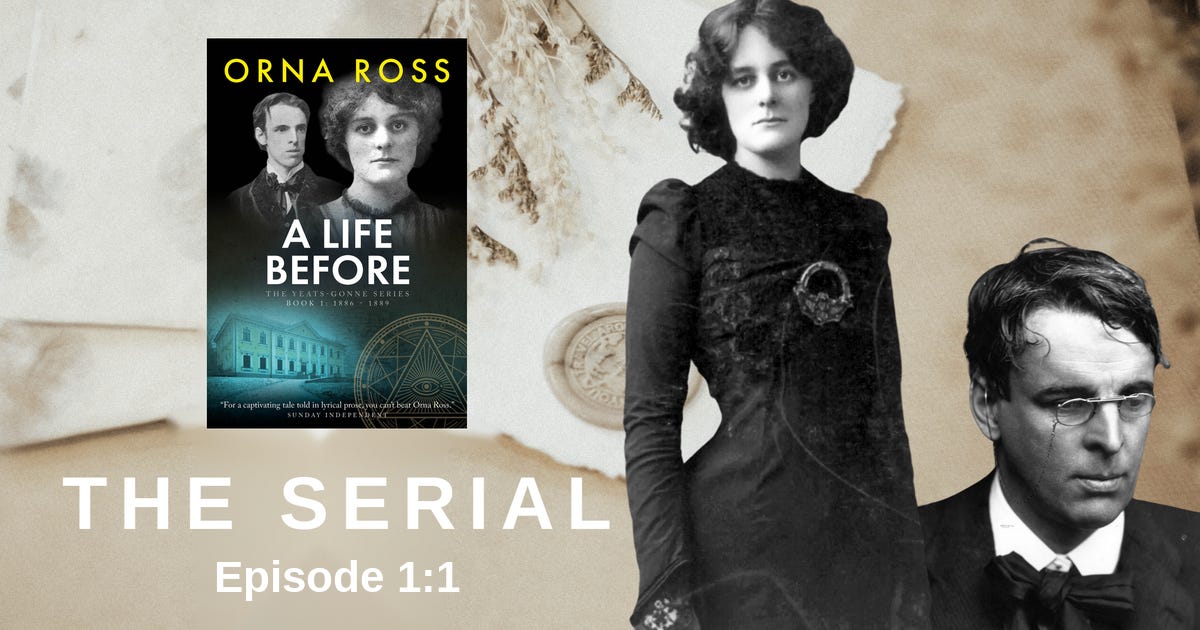
Welcome to A Life Before, my next novel, which I’m publishing as a serial, here on Substack.
This literary-historical novel is based on real events in the life the English heiress turned Irish revolutionary, Maud Gonne, and the poet she inspired, W.B.Yeats. What made them who they were and why was their meeting, and subsequent collaboration, so explosive?
This coming-of-age story of passion, intrigue, and spiritual ambition set in 1880s Ireland, England and France, is narrated by Rosy Cross, ‘the oldest woman in Ireland’ who’s not shy about offering her opinion.
Each episode here forms a standalone story that, taken together, build to the complete novel. For readers who like true-life historical fiction, slow reads, Irish settings—and being close to a work as it’s being made.
- New? Begin at the beginning here with A Strange House of Time
- Returning? Find your place with The Story Index or scroll down for Episode 1:1.
<— Story Index | Next Episode
NOW READ ON:
Come in, come in. It’s very welcome you are. Come on in and sit yourself down. You’ll be wanting to know my name, I suppose, if you’re to trust me with this tale. I’ll give you that in a minute but advance notice for you from the off: I’ll be keeping myself to myself in this book.
This story belongs to Maud Gonne and her poet, W.B. Yeats. I’m only the mouth it found. W.B. once said that ‘words alone are certain good’, and all the writing in the world is born of that notion, but for me the most certain good is quiet. Not shame’s stiflings or fear’s withholdings but the other kind: the great silence that’s always there, holding all, without a lick of blather.
We Irish do love to blather. Yes, I’m Irish, if you haven’t gleaned so already from the turn of my tongue. An Irishwoman who’ll admit to being no better than she should have been, for many a year, and one who gave the first half of her life to the cause of Irish freedom, back in the days when that was a dangerous thing to do. Two wandering paths I took in my long life, both pointed at what I called freedom.
So a hundred thousand welcomes to you now, in freedom’s name. Rosy Cross here, at your storytelling service. The name suits me a hundred ways round, for I had a cross mother, and three cross fathers, but I was saved by the holy cross of the secret rose, and thereby came up rosy. Rosy.
You might have heard of me for being the oldest woman in Ireland? Well past my hundredth year I am now, and with a bounty each year from the Irish president herself to prove it. The doctors have been saying for years it’s all up for me and sooner than later, they’ll be right—but, please to all the goddesses of the in-between, not until I’ve had enough time to finish this book and say what must be said.
For the world has again forgotten what it needs to know, what Maud Gonne and W.B. Yeats knew more than most, and to pass it on, before it’s too late, is my job here now. Well shall I tell you, never fear, for well indeed I remember, old though I am. It’s a strange house of time you inhabit at my age—what happened yesterday I can hardly recall, but the bygone days shine clear.
I grew up in a village called Graignaspiddogue, in the county of Carlow, raised and fashioned by one mother, three fathers, and a great band of relations—all of us overseen by my mother’s mother, Nana.
It was Nana who named me Rosy, after a poem she loved, ‘My Dark Rosaleen.’ And so, with my first father being James Cross Esq., I became Rosy Cross. I was well into my life before I learned the other meaning of that name as sign and seal for the Rosicrucians: medieval quill-wielders and star-counters, who trafficked in alchemy and angels, symbols and whispers, keeping old knowledge alive in forbidden books.
Quill-wielding and star-counting is my trade too, handed down from Nana, not by cipher but in the way of old Ireland. The medievals of Europe had their wands and pentagrams, The Cullens and Crosses of Graignaspiddeog had our faery mounds and holy wells.
‘Always remember, a grá,’ she used to say, as if foretelling the days when I’d find myself among the murderers and ne’er-do-wells, ‘No matter how black-hearted a person turns, they were born a baby thirsting for their mother’s breast.’ Nana loved motto talk like that, and fairy-tales and pishogues, any class of a story, truly. Stories invented and true, tall and small. Stories with a point and those past all fathoming.
‘Fadó fadó,’ she’d begin, her Irish way of saying Once Upon a Time, only twice as long ago. ‘Fadó fadó, there was a girl… there was a boy… there was a creature… there was a god…” And then she’d be off and yourself along with her.
Her favorites were the old Irish tales about the gods who’d stepped down to inhabit the land of Ireland, taking on the forms of the place. The Tuatha Dé Danann they were called, and they’d ruled the whole of Ireland once but were bested by foes, and had to take refuge in the little mounds of land known as sídhe (‘shee’, fairy forts). They’d had to shrink to fit, these great beings, and now went by the name of the hidden world that gave them asylum. The Shee.
By the time my time had spun round, they could be seen only in flashes, when they slipped out—usually around dusk or dawn—to have a meddle in the human world. Those who knew no better believed in their diminishment, and called them leprechauns, and saw their showings as mischief. Nana would have none of that. She gave us the old understanding of them as majestic beings, full of grandeur and sorrow, woven into air and water and earth and fire. They had their own wise logic that only looked like tampering if you hadn’t the soul to see rightly.
Nana saw sightings of the Shee everywhere and taught us to respect their kinship and their guardianship. A hare darting quicksilver across the meadow was the goddess of the moon and the wild, Bé Chuille, sharp in her dealings and swift in her wit. A rook perched in the old oak was Éber Donn, the wise king, renowned for the magic and healing of his reign. A skylark leaping into the sky and spilling its song was Amergin, one of the old bards. ‘Would you look at him,’ she’d say, ‘shooting up like he was fired from a slingshot. Look how he hangs there, hovering, perching himself on an invisible branch, observing the doings of the day. Singing about what he saw yesterday while gathering in a tale for tomorrow…’
Yes, I grew up in a twice-peopled place, where the dead were folded into the living, and if I set my soul rightly today, I can still read a rock, a sky, or a field through my skin, and see Nana’s hair in the reeds of a riverbank, and hear her voice whispering through the air. Lean in too hard and she vanishes, but breathe soft enough, and up she rises.
Watching Nana work her spell on others is what gave me my own grá (love) for story. I’d scour the delight or the disdain on our neighbours’ faces as they gathered around her fireside and wait for the wonder that would shoot up when she came to a twist or a character surprise. This being a book, I can’t see you from here, but I like to imagine you the same, turns of feeling passing across your face as you turn the pages.
Maud Gonne and W.B. bent the knee to the same spirit as Nana, and the men and women of the holy cross, and their own versions alike. Folly may don a mask and mean it but—whether dressed in the landscape of Ireland, the robes of the medievals, the astrological system or a poet, or the goddess tableaus that Maud Gonne and her ‘Daughters of Ireland’ set out on a Dublin stage—wisdom behind all its veils remains ever the same.
The clockwork heaven W.B. created, with its solar and lunar rooms and gyres within gyres, was the same truth Nana carried in her apron pocket. ‘Willie, a grá,’ she’d have said if ever she met him. ‘You had it. You had it in the poems.’
He may have over-egged his pudding but it’s our shared devotion to what lies behind the veil and sets it trembling what makes me worthy to tell this story. Though I knew the famous pair in the flesh, as all the Irish-Irelanders knew each other back in the day, and though I read every bit of their treasure hoard of writings, I wouldn’t have been equal to this book had Nana not taught me how to listen at the seam where the dead fold into the living.
I had to wait a long time to know what she knew truly—so now let’s get on with it. I’ll say my say, and then the story will be yours, dear reader, to mind or mangle as you will, and old Rosy will slip onwards, into the great silence. Over and out and glad as you please I’ll go—though I can’t promise I won’t blow you back the odd whisper.
Away with us, so, to a time when women wear bustles like bellflowers, men wax their whiskers to a wicked shine, and children are sent down mines and up chimneys, without so much as a prayer. It is the year of 1887, a time when the old faith-wars are cooling but the new flag-wars are catching, and Maud Gonne is lying awake before dawn in the French spa town of Royat, sobbing over a man.
Here we have as fortunate a girl as has ever been born, blessed with the kind of beauty that makes ballrooms lean her way, and the kind of money that could itself start a small war, if so inclined. Yet looking ahead, she can see nothing but an upholstered prison of drawing rooms, dining rooms, dressing rooms, stripped of meaning. She turns her face towards the shape of her sister in the dark, an indistinct mound in the other bed. ‘Kathleen, are you awake? Oh Kathleen, what am I to do?’
Though she’d been circled round the same question for hours the night before, Kathleen slips out of bed and comes across, feet bare on the creaking floorboards. ‘Dearest, have you slept at all?’
Maud Gonne shunts over to let Kathleen into the warmth. ‘Hardly.’
‘I cannot bear to see you like this.’
‘Oh Bear,’ Maud Gonne lays her head on that soft sisterly shoulder and cries more tears from eyes already hot enough to blister Heaven. ‘I simply must see him again.’
‘Maud, you cannot be serious?’
‘Oh don’t misunderstand me. I know we must part, but I must explain to him. I cannot just stop seeing him, without explanation.’
‘Dearest Maud, you are too tender-hearted.’ Kathleen strokes her sister’s damp hair. ‘No explanation is necessary. He must have been expecting this. He will understand why a further meeting is impossible.’
Kathleen cannot conceive how her sister—she who only ever laughed at men, who disdained marriage as bondage, who treated flirtation as a high art—can be so reduced by this Monsieur Millevoye. Such a French gentleman, so impassioned with causes, all black eyes and burning words, yet arranging his sighs before releasing them, as if he gave every sentence a little bow before sending it into the room. And positively aged, surely near forty. Kathleen can’t imagine him ever running or jumping, or doing anything youthful or spontaneous as her sister does, from a rush of joy.
‘Won’t you help me, darling?’ Maud Gonne pleads. ‘Can you cover for me at breakfast?’
‘You know I cannot.’
‘Bear, please. I must—’ But here a fit of coughing takes her, and she is forced to sit up. Kathleen is up in the same breath, snaking an arm around her waist. Oh, that cough. For half a year now, that sound has plagued them. That’s why they’re here, in this little town where steaming stones and sulphur kisses have been curing people’s troubles since Roman times.
Seven months ago they lost their father, to typhoid. Dear Tommy, Colonel Gonne, the fixed star of their world. Neither of them, truth told, has found her way to be without him yet. ‘Taking the waters,’ Aunt Mary called it, as she removed them from the abrasion of their English relatives who didn’t know what to do with them, and brought them here to Royat, this spa-town blessed with mountain air fresh but not too sharp, summer weather warm but not too hot, and its famous spring waters alkaline but not too salt.
Royat sits on the edge of the Limagne plain in the Auvergne region of France, just where flat land buckles into a chain of long-dead volcanoes. Here dainty ladies and doughty dowagers, play-acting princes and pocket-rich parvenus, all come to blow and splash together with the officers from the nearby military camp at Clermont-Ferrand. By day, they soak in marble baths deep as baptismal fonts, or stand under pounding jets to be sluiced like yearling colts, or bend over bowlfuls of the water, with towels over their heads. Some even drink it, by the glassful, wincing at its whiff (like bad eggs) and taste (old pennies). Then, come evening, glowing like stoves they take themselves out, to enjoy fine wines and sweetmeats in the white-linen restaurants, safe in the knowledge that wealth is health.
The waters seem to have worked their magic on Maud Gonne. She is able to walk easily again now, even on the hills. Or had been, until yesterday. Kathleen sends up a prayer that this trouble with M. Millevoye won’t cause a backslide. Her sister’s lungs are her heart’s barometer.
She reaches for the glass of water beside the bed, presses it into her trembling hands. ‘Drink.’
Maud Gonne takes a sip, eyes shining huge over the glass. ‘Darling, you are not truly going to refuse me?’
‘There now. Just drink.’
‘I shall take all the blame if we are caught.’
Caught they surely shall be—and yes, Kathleen dreads their aunt’s histrionics, but that’s not the knot of it.
‘Please.’ Maud Gonne takes tight hold of her wrist.
Her intensity strikes fear into Kathleen. ‘You’re not planning to elope with him, Maud?’
‘Of course not. You know I don’t intend to marry for decades… if ever. And he cannot leave Général Boulanger.’
Yes, Kathleen has heard M Millevoye speak of Boulanger’s and France’s need of him, the way their father used to speak of military duty.
‘The future of France depends upon his allegiance,’ says Maud Gonne. ‘And anyway…. and also…’ But this thought only stirs a fresh commotion of sobs.
When their father went into the ground, Maud Gonne never cried. Not then and not since, which everyone thinks most unnatural. Furious outbursts and declarations of independence, yes, and a flurry of activity as she tried to carve out a career on stage, but no sign of sorrow. Kathleen wonders if today’s extravagant distress is not for this Frenchman at all, but delayed grief for Tommy?
Colonel Gonne—Tommy always to his girls—was a British army officer who travelled the world on diplomatic missions, and rarely around. A loving father but the Empire got the best of him and his girls were ‘army orphans,’ forever being moved from place to place, and friend to relative, until three years ago, when he finally landed a desk job. Assistant Adjutant to the crown forces in Ireland. A cushy number to see out his career.
What a joy that was, to live as a family for the first time since Mama died in a set place, even if that place was an army barracks. Much to the disgust of the English relatives, Maud Gonne persuaded him to let her leave school and act as his secretary and hostess and housekeeper, Only then he was struck down, in his prime, at just fifty years old. Not a word of warning and not a thing to be done about it, except get over it.
Kathleen waits out her sister’s coughing, hoping it might put an end to her badgering, but as soon as Maud Gonne has her eyes dried, she resumes with even more vigour. ‘Oh, won’t you help me? Dear Bear, say you will. I know I ask a lot but it’s the last thing I shall ever ask. Once I have broken with Millevoye, I shall never again need to ask anything of you again.’
She means it as she says it, cross her heart, but though Kathleen doesn’t believe her—the childish belief she once held in whatever her big sister said has long since departed—still, they are true sisters. Unshakeably bound: firstly by the loss of their mother so young, then by being shunted around their English aunts and uncles like lost parcels, now by the loss of their father.
Halved by the same tragedies, they have always doubled into each other.
Kathleen sighs. ‘What exactly do you want me to do?’
READ MORE: | Story Index | —> | Next Episode 1:2. the first meeting between Maud Gonne and the elegant Boulangist politician Lucien Millevoye.

Loving this so far, Orna! The voice of Rosy rings so rich and true. I felt like I was sitting down with her in a cosy armchair, drinking tea while she chatted.
I am looking forward to the next installments - and I will also eagerly be following how the experiment of serialization unfolds 😌