

1:2. Drowning Herself for Pleasure.
In which Rosy Cross takes us back to the first meeting between Maud Gonne and the elegant Boulangist politician Lucien Millevoye.

A LIFE BEFORE The Story So Far: Our narrator Rosy Cross, ‘the oldest woman in Ireland’, and an Irish-Irelander, takes us to the French spa town of Royat in the Auvergne, where Maud Gonne—beautiful, wealthy, and newly fatherless—is devastated by news she has just learned about her latest beau, the elegant and inspiring French politician Lucien Millevoye. SCROLL DOWN TO READ ON
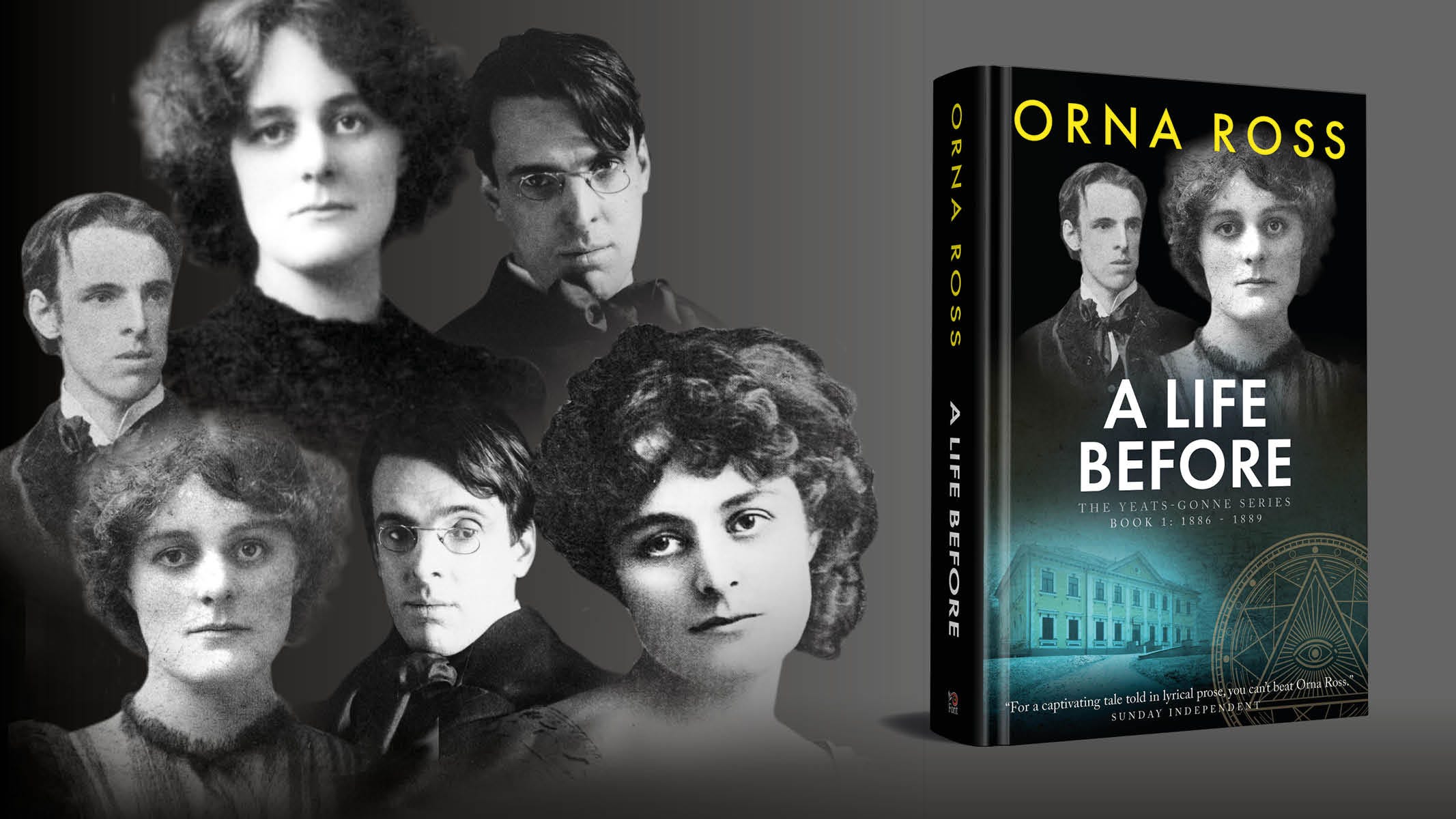
A Life Before is a literary-historical novel, based on the true life story of the English heiress turned Irish revolutionary, Maud Gonne, and the poet she inspired, W.B.Yeats. A story of passion, intrigue, and spiritual ambition set in 1880s Ireland, England and France, it is narrated by Rosy Cross, ‘the oldest woman in Ireland’. Each episode forms a standalone short story or flash fiction that, taken together, build to a whole.
The 2nd story is below. Begin at the beginning with Story 1: A Strange House of Time or find your place with The Story Index
Previous Story <— | Story Index |
2:1. Drowning Herself for Pleasure.
Mostly, Royat is blessed with a courteous sun, and air so clear you’d think the weather itself had invested in the business of cure. Every once in a while, though, Puy-de-Dôme, the huge dead volcano cone that towers over the town, gets in a mood and shoulders up a thick bank of cloud that turns everything clammy. It was under such a sky that Miss Maud Gonne first met Monsieur Lucien Millevoye.
She was sitting by the bandstand with Kathleen, their great-aunt Mary the Contesse de Sisserane, and friends. Though the music was finished for the day, all were reluctant to move, enervated by the deepening humidity. Maud Gonne found herself simultaneously bored and full of a prickling premonition. ‘Something’s going to happen,’ she whispered to Kathleen.
‘A storm,’ her sister said, looking anxiously skyward from behind her over-active fan. ‘I dearly wish Aunt Mary would take us inside.’
Then two gentlemen approached with bows and salutations. Aunt Mary introduced her nieces to M. Paul Déroulède, leader of the Ligue des Patriots. He in turn presented the Comtesse de Sisserane and her charming nieces to his friend and associate, the renowned journalist, M. Lucien Millevoye
Maud Gonne felt sure she had seen him before. Was it at Paris Opéra? Fashionable waxed moustaches, she noted. And exceedingly tall, one of the few to top her own six feet. He bent over her hand with an ‘Enchanté, Mademoiselle,’ and a scorching gaze.
M. Déroulède mentioned to Aunt Mary that M Millevoye was another ally of Général Boulanger.
‘Ah how valiant,’ she remarked. Then with her hostess trick of always finding the connection point between people, she said, ‘My great-nieces’ late father was a military man.’
The two men bowed to the two young ladies.
‘And is the rumour true?’ Aunt Mary wondered. ‘Is Royat soon to play host to le brave général?’
Though old enough to remember what havoc a strong man on a horse can unleash, Great Aunt Mary had a soft spot for General Boulanger. He had the whole place besotted, truth told, with the new newspapers popping up everywhere playing the populace and declaring him France’s great hope. You could buy Boulanger toys for the nursery, have Boulanger soap on your washstand, eat Boulanger sweetmeats with your tea. There was a song of his impending victory that even the children sang.
‘Might we, do you think, meet him?’ Great-Aunt Mary asked, with a simper.
‘Certainement Comtesse!’ M. Millevoye declared, speaking to the aunt while keeping his eyes fixed on the niece. ‘I shall see to the introduction myself.’
Maud Gonne felt a mad urge to jump up and dance about the place but she made herself sit, twirling her parasol and her sense of déjà vu. A sky-rumble rolled over the town and with it a gust of wind that turned the leaves of the lime tree, showing their pale undersides. ‘Thunder,’ cried Kathleen, her fan fluttering like a small bird in sight of a hawk.
‘Monsieur Millevoye,’ Maud Gonne said. ‘I believe we have met before?’
‘Mais non. If I had met you, Mademoiselle, I should never forget.’
‘I’m sure we have met somewhere, sometime,’ she insisted. ‘But it is too hot to think.’
A few heavy drops of rain started to fall. ‘Come! Come!’ cried Aunt Mary, her hand to her hat. ‘Back to the hotel, girls!’
‘We shall see you safely there, Comtesse,’ Millevoye said, as great fat spatters of rain began to smack the ground. ‘After you, Mesdemoiselles.’
They made it to the hotel portico just as the sky flared with a white flash of lightning and a crack of thunder. The heavens started to spill and Great-Aunt Mary invited the gentlemen inside to wait it out. Up they went to the suite where Figlio, Aunt Mary’s young secretary-cum-lover, was drawing the curtains to shut out the storm. Drinks were served, the comtesse called for music, and Figlio took his place at the piano.
His playing was flawless, but Maud Gonne had no wish for music, and was frustrated by this concealment of the storm. She slipped through the heavy curtains, out onto the roofed terrace. Thunder rolled back from the mountain and lightning flashed over them again and again, while from the garden below, rosebushes lashed by rain sent up an intoxicatingly sweet perfume.
She was tempted to go down into the downpour, and let it wash over her, but the thought of her new dress held her back. She stretched her bare arms out into the rain and closed her eyes to better feel the mercy of cold rain needling her skin. When she opened her eyes, the tall Frenchman had appeared, quiet and sudden as a priest at a deathbed, from behind the curtain, and was watching her.
‘Oh M. Millevoye, you startled me.’
‘Your aunt has sent me to fetch you in. She is fearful for you.’
‘But how can one leave a storm such as this?’
‘Yes,’ he said, ‘it is much better out here than inside, if you are not afraid.’
‘One must never be afraid of anything.’ This was Tommy’s doctrine, spoken to her when her mother died, and so never forgotten.
‘Anything?’
‘Anything,’ she insisted. ‘Not even death.’
‘Death? What a thought in one so young and so… so… resplendissante de vie.’
‘I have always been careless of death. I believe that’s why I have survived so long.’
‘My dear Mademoiselle, you are all of—what?—eighteen, twenty? You need hardly fear death just yet.’
Later she would tell him of the mother and baby sister who died when she was just five years old, of the father lost so suddenly, and recently, of the poorly lungs that have troubled her since childhood. And she will learn that he has long suffered the same complaint. For now she said, ‘Oh I don’t think of death at all. I think only of life, and how it might be best lived.’
‘That is easily answered.’ The Frenchman stood a little closer. ‘Life is best lived in love.’
‘A pretty answer, Monsieur,’ she said, taking a step back. ‘But for a girl, love runs to marriage.’
He chuckled. ‘I thought all beautiful young ladies wished to marry.’
‘I shall be twenty-one at the end of the year, and finally free of the bondage of my elders. Why should I walk straight into the bondage of a husband?’
‘Ah, rebellion! You English girls. Such fire under the frost.’
He closed the gap between them again, was so near now that she could see the terrace lamps in his eyes, streaks of orange amid the green. From his jacket, from his linen, from his skin perhaps, came a very subtle perfume, overlaid with cigar smoke.
‘Where have we met before?’ she whispered. ‘I have met you. Do try to remember.’
He took this as an invitation, put his arm around her and kissed her hand, his moustache brushing the blue pulse at her wrist. When he met no resistance, his lips travelled up her rain-wet arm, slowly and deliberately. In Hollywood films to come, they would make great sport out of this French carry-on, but what it did to the young Maud Gonne was no joke. A new feeling unfurled in her that she had no name for, a feeling that made her panic, and then question why.
‘We speak a different language, M. Millevoye,’ she said, as she carefully, deliberately, retrieved her arm. ‘Come—as you say, my aunt will be anxious. Let us go in.’
‘Enfin!’ Millevoye announced, throwing his voice ahead of them as they re-entered the drawing room, where Figlio was keeping the music going. ‘Here is your prodigal niece—rescued from drowning herself for pleasure.’
‘Oh Aunt Mary! Kathleen! The thunder was glorious.’
The comtesse sniffed. ‘Young ladies view from a window.’
‘Mademoiselle Gonne spoke to the storm as if it were an old friend,’ said M. Millevoye. ‘And, of course, it obeyed her.’
Maud Gonne laughed a tinkling laugh. ‘I think you make a profession of flattery, M. Millevoye.’
‘Au contraire, Mademoiselle, I make a profession of truth.’ He laid his hand on his heart, as if swearing a civic oath. ‘It is the politician’s only weapon—though we use it, perhaps, with more art than most.’
‘Artful truth?’ she teased. ‘We shall have to watch those words of yours with care.’
Millevoye’s eyes circled the room and he gave a small bow. ‘As a servant of Général Boulanger and of France,’ he said, his eyes returning to Maud Gonne, ‘I hope to be worthy of such attention.’
READ MORE: |Previous Story |<— | Story Index | —> | Next Story in which the courtship deepens through politics, poetry, and sightseeing drives—until Great-Aunt Mary drops a cannonball on the drawing-room rug.
So enjoying this book! I've only read the first two chapters and can't wait to read more.
I prised a gelato, house red, and pizza waitress on New Moon's eve with a humor similar Lucien's pledge, "Life is best lived in love," with my posit for the New Moon: "True Love is a shared anxiety." She came back a few times, then mastered anxiety to prophesy, "We will both find true love." Mais oui, mais non.