


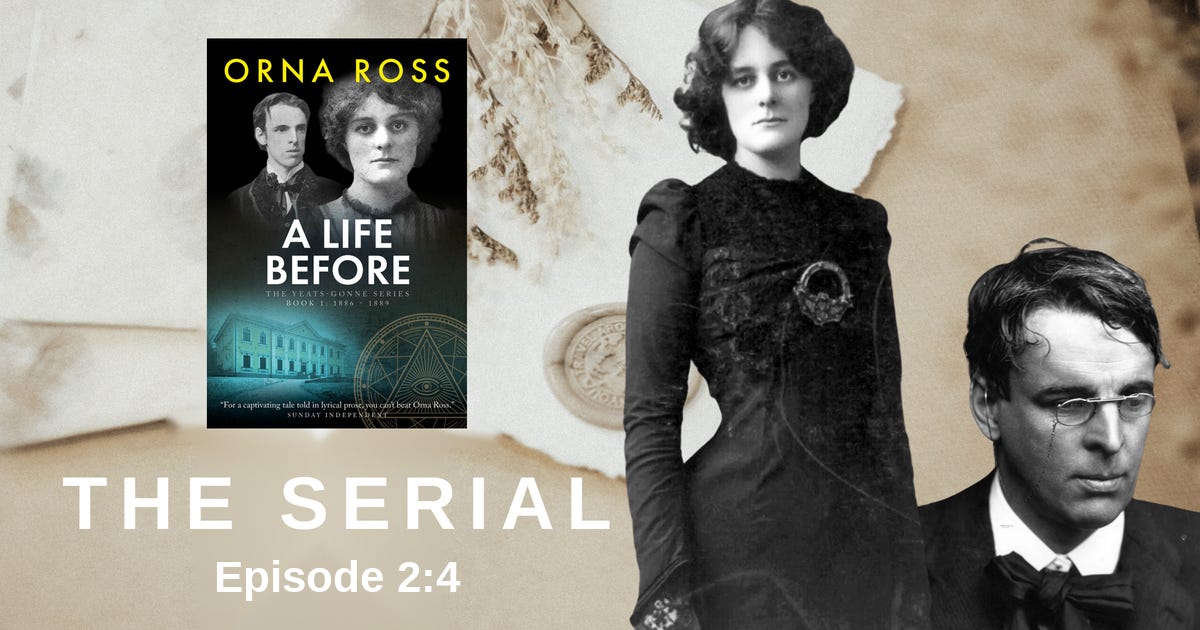
Welcome to A Life Before, my next novel, which I’m publishing as a serial, here on Substack.
This literary-historical novel is based on real events in the life the English heiress turned Irish revolutionary, Maud Gonne, and the poet she inspired, W.B.Yeats. What made them who they were and why was their meeting, and subsequent collaboration, so explosive?
This coming-of-age story of passion, intrigue, and spiritual ambition set in 1880s Ireland, England and France, is narrated by Rosy Cross, ‘the oldest woman in Ireland’ who’s not shy about offering her opinion.
Each episode here forms a standalone story that, taken together, build to the complete novel. For readers who like true-life historical fiction, slow reads, Irish settings—and being close to a work as it’s being made.
- New? Begin at the beginning with A Strange House of Time
- Returning? Find your place with The Story Index or scroll down for Episode 2:4.
<— Previous Episode | Story Index
The Story So Far: Reeling from the sudden death of her beloved father, Maud Gonne has fallen in love with a Frenchman almost twice her age—the journalist and aspiring Boulangist politician, Lucien Millevoye. They have also formed a political alliance—she will help him to achieve his goals in France if he assists hers in Ireland. Gonne has travelled to St Petersburg on behalf of the Boulangists, with secret papers sown into her dress for delivery to the Tsar. But will their Russian contacts prove faithful?
NOW READ ON:
When Maud Gonne was young, Tommy would send for herself and Kathleen at holiday time, to be brought to some interesting place near wherever he was stationed. Each day of his leave, he’d bring them on outings to the galleries and the theatres and the old junk shops, and nothing pleased him better of an evening than to hear his two girls setting cities side by side in their talk, weighing this one against that, like laying out ribbons. A regret was that he'd never got them to St Petersburg, a city like no other that hadn't come up in the way of most towns, house by street and shop by scandal, but had been commanded into being. Willed out of dark water and unstable ground by an emperor who wanted to face Europe.
No mention made of the thirty-thousand conscripted souls sacrificed in its making, how it was mortared by the bones of men fatigued, frozen and fevered to death but the Colonel was wearing the emperor's coat back then, and seeing with emperor eyes. Arriving in, Maud Gonne instantly understands her father’s fascination. Everything is different here. The light itself is foreign—low, rose-coloured, and brief, gone by three in the afternoon. Then all the lamps come on together, and the frost on every tree and railing catches fire, and a stand of palaces the colour of sugared almonds rises over the frozen river, burning against the snow in domes of beaten gold.
After a flying ride from the station in a sledge, bell ringing at every turn, she comes into the Grand Hôtel d’Europe with frost still on her lashes. The letter from Madame Adam to the Princess Catherine Radziwill lies folded and ready in her handbag, but it is never presented. As she stands at the reception desk, signing her name into a register the size of a church bible, a voice arrives at her shoulder.
‘Mademoiselle Gonne, je présume?’
She turns to see a petite, dark woman in impressive furs. Diamonds in her earlobes at three in the afternoon. Bright eyes that went over you the once, like the customs man at the frontier, only without the hostility. Just noticing. Noticing everything.
‘Princess Radziwill?’ She asks it doubtfully. Could this glamorous young woman possibly be the mother of eight children? She looks too beautiful, too fresh, but yes indeed, the Polish princess it is. ‘You must be exhausted, Mademoiselle? But I should be honoured if you would take refreshment in my rooms.’
Maud Gonne, who could dance till Lent on an hour’s sleep, pronounces herself not exhausted in the least, and arranges to be there in half an hour. Upstairs, she has time only to notice that her rooms are grand as a cathedral, with a stove of white porcelain going floor to ceiling and throwing out a heat you could lean on. The candles double themselves in the frost-flowers on the glass, so that every flame burns twice, once for this world and once for the other.
She changed into a tea-dress, at a speed learned backstage in amateur theatricals, where the costumes were fewer than the players. A quick toilette, and she leave the maid to the unpacking, and makes her way along the corridor and up the stairs.
The Princess has been a month already in the hotel, while she hunts out a house, and her room, cut from the same marbled splendour as Maud Gonne’s, has surrendered to her. Her shawls lie over the plush, her own miniatures stand on the mantel, and her books and papers and periodicals totter in stacks all around. On the secretaire the remains of newspapers out of four countries have been gone at with scissors. Cuttings spread around it on the carpet, pinned and crossed like a general's maps.
Maud Gonne sits to the refreshment, which is delightfully Russian: tea taken with a spoon of jam; sturgeon and other little salted things on triangles of toast; vodka going round like cold silver. The Princess is all lightness as she pours. She admires her guest’s dress and the travelling costume she'd seen her in below—the veil especially: was that à la mode in Paris now? Did Miss Gonne have a fur cape? She simply must, there was no surviving St Petersburg without one. Only one furrier in the city is worth the name, she’ll have the directions sent to her room.
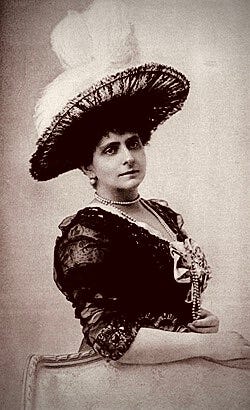
Then she shares the story of her life. Born Ekaterina Rzewuska—‘but just call me Catherine, all the Europeans do’—in this very city of St Petersburg, into Polish blood and old Polish money. At fourteen, on a visit to Paris, met the love of her life, a rising man of the Tsar’s secret police, only to be married off by her family a few months later to the Prussian, Prince Wilmhelm Radziwill. Brought to Berlin, to commence the breeding required of a royal wife. Here she shudders, describing a dour household of in-laws and a starched Prussian court, and one child after another until she thought she’d die of it. Only her friends, who included Princess Vicky, the Queen of England’s daughter, made life worth living, but now her love—whom she cannot name, for reasons of diplomacy—has come back into her life and carried her off. So here she is, embarking on a whole new life.
Forgive her, she does not normally share these details but Miss Gonne seems so kind, so understanding.
Maud Gonne didn’t like to ask what the move meant for the eight children. Instead she shares her own story in return. Kathleen and their itinerant childhood, Tommy and the typhoid that took him, the great stage-career that was to be, the lungs that bled it away, her devotion to Ireland and determination to do something worth doing for her country.
The Princess is most interested in her time at Royat, and asks a great many questions about the doings of Général Boulanger and his followers. Many Maud Gonne cannot answer, and on some she withholds, without quite knowing why.
Millevoye she offers as 'a friend of Madame Adam's circle who would soon be with them.’ The Princess receives this with a face smooth as the jam she is stirring into her tea. 'Juliette wrote me a thorough introduction, you know.'
Maud Gonne blushes, says, ‘Then you'll know we are here as emissaries.’
‘What a funny thing you are. Your… emissary arrives tomorrow, no? Meanwhile, you and I shall dine together this evening, and I shall introduce you to St Petersburg.’
Dinner with Princess Catherine is the best entertainment to be had in all of St Petersburg that night. She set them up at a table by the door, her toll-gate, and gave Maud Gonne the whole company, name by name, making a charge on the reputations of all who passed in or out—this one’s mistress, that one’s debts, what the other’s doctor was treating her for. It was like being walked through a portrait gallery with a scurrilous tag attached to each frame. She laughed till the next table looked and was fed another scandal, one worse again, for her reward.
They were at the sturgeon when a suit of rough tweed came by, with a square-built Englishman within—forty or near it, a beard the colour of wet sand washed grey, and eyes blue as a gas-flame. ‘Mr William Stead,’ Princess Catherine whispered as he came on. ‘The most infamous journalist in England.’
And then—no discreet nod, no waiter sent over with a folded word, none of the machinery Aunt Mary had spent years installing in Maud Gonne—she simply called out, gay as a market woman: ‘Mr Stead! Come and meet Miss Gonne!’
Stead approached the table with a long look of appreciation at Maud Gonne. Forks paused on the surrounding tables. A lorgnette came up to look closer.
‘Princess Catherine.’ His bow was fast and flat, that of a man who keeps his knees for chapel. ‘So I am to be hailed across a public room, like a cab. Every capital in Europe has tried to reform you. I see none has managed it yet.’
‘They do keep sending me their dullest people for the work,’ said the Princess. ‘Miss Maud Gonne, this is Mr William Stead. Fresh out of one of her Majesty’s gaols not three years hence and prouder of it than Général Boulanger is proud of his medals.’
Stead gave her a hot look. ‘The General’s badges were won facing the enemy’s guns, Miss Gonne. Mine facing England’s respectable classes. I rather think his was the safer post.’
‘Miss Gonne is the eldest daughter of the late Colonel Gonne who died at Dublin. She intends to repay the English Army by freeing Ireland.’
‘So I heard.’
Maud Gonne wondered how. In St Petersburg she had shared these details only with the Princess.
‘Oh don’t look so astonished, my dear. This town leaks like a Thames barge.’ His gas-flame eyes narrowed, and came to round on her at full force. ‘So… you believe you can succeed where Wolfe Tone failed?’
He was making fun of her—the light, licensed fun a man of forty allows himself with a beauty of twenty.
‘Wolfe Tone failed, Mr Stead, for the want of a French fleet that could not land in a storm. I do not intend to depend upon the weather.’ She gave him a smile with the words, to acknowledge that she knew it was an outsize, fantastical mission for her to speak of cutting up the British Empire over the fish.
‘Hmm… So you go beyond Home Rule? You are for an Irish Republic?’
‘A kept nation is no nation, Mr Stead.’
‘Taken by force?’
‘Peacefully if possible, of course.’ He is making her squirm with his interrogation. Lines kept arriving in her and handing themselves over to him. ‘But alas, it is England who will decide how peaceful it may be. I am not hopeful.’
‘So—by the sword?’
Tommy’s word, that. In her girlhood it had meant a clean blade, an open field, a declared quarrel. Never being afraid of anything, not even death. Mr Stead's flat English delivery set a different memory rising in her, unbidden. An assassination under dark that had happened on their very first day back in Dublin, just as Tommy took up his new post.
He’d brought them to the Kildare Street Club in the afternoon to watch the state entry of the new Lord Lieutenant of Ireland—the coach drawn by four magnificent horses, led in by marching bands. The streets were lined with military and police keeping order and all passed without incident. Only later that night, while she and Kathleen and Tommy were celebrating their new-landing as a family at the Royal Barracks, less than a mile off two of the new administration’s highest, two men known to Tommy and set to serve alongside him, were cut down while walking home through the park. Assassinated with surgical knives and left dead in the grass.
Those murders had come to her then as an intimate shock—the knives an inch, it felt, from their new front door and all her Dublin seasons after, the ladies' talk ran along the line of the shocking state of the country, the insolence of the disloyal, was it safe at all to drive out, but that way of seeing had been left out of the trunk she packed after Tommy's death, and behind the door she slammed on her way out the barracks.
‘I believe, Mr Stead, that England’s treatment of Ireland means whatever an Irishman may does in retaliation is an act of war, not a crime in the ordinary sense.’
‘You include the bomb?’ He means the Irish dynamite war in England, the clock-work parcels that have maimed ordinary people alongside police and parliamentarians. Three years now since the last of them went off in London, but yes—that horror was harder to answer. She would not give him the retreat he was after, though.
‘You’ll assent to the proposition, Mr Stead, that omelettes cannot be manufactured without the breaking of eggs?’
Lines keep arriving in her from she knows not where. If some ring with the Colonel’s parade-ground brass or, like that one, have a French accent around the unworthiness of a nation that yields one inch, she does not notice.
Stead considers her with new interest. ‘I see. Well, I suppose at worst your passion will bring a picturesque hue to the Irish question.’
Princess Catherine says, ‘Mr Stead, Ireland stands like a wife under the law, does she not? Her property is English, her earnings too, her signature worthless without his say-so. Miss Gonne does not intend to live so as a woman—and she’ll not have her country live so either. That does not make her a Fenian bomber… or a pretty ornament.’
‘Such enthusiasm in one so beautiful is certain to make an impression in Hibernian quarters, Princess. Miss Gonne needs managing, not defending.’ He looks from the Princess to the girl and back, a man re-doing a sum that seems to have come out larger than expected, then for the first time that evening, addresses his answer to her and not to the table. ‘Come and see me before you go any further. I can perhaps introduce you to some people you will need to know in London.’
And on he went.
Maud Gonne turned to the princess. ‘Picturesque. Is that how I am to be received in London?
Princess Catherine had returned to her plate.
‘Ought I to see him, do you think?’
Her companion took her time over a triangle of toast
‘I suppose it cannot do harm?’ She is also wondering how Millevoye will take Mr Stead and his attentions. Should she serve it to him as a triumph, or fold it small?
‘I do not yet know if Stead is useful to our cause,’ Princess Radziwill said with a sudden bad humour. ‘What brings him to St Petersburg? He seeks an interview with the Tsar, he says, but why? If he does meet with you, please see what you can find out.’
Maud Gonne gives her promise.
‘And a word, my dear, for you are very young. If you are to do good work from Ireland, you will need be more circumspect.’
Circumspect. This from the woman who is professional indiscreet and flamboyant, but Maud Gonne takes it, meek as milk, and banks it where she banks all advice. She has become a collector of what clever women tell her, and this goes into her collection, stored for safekeeping, on the chance that the day will come when she might need it.
She sleeps the sleep of the newly landed, and next morning she is awake before the maids. The hotel cannot hold her. Excitement has her up and out while the lamps are still burning, seeking to break her fast at a local café, more appealing to her today than the formality of the hotel. Down towards the river she goes, her travel costume back on, with an extra cape for warmth. The princess had sent the furrier details and a purchase will be made, first thing.
The knowledge of the sewn-in document has gone from privilege to itch and she looks forward to its unstitching this afternoon. Millevoye has the shoulders to carry the future of France. For her, it has been daunting. Her breath flies back over her shoulder, like a scarf, as she walks and the snow squeaks under her boots. St Petersburg has made a religion of the cold but the cold too is different here—none of the damp of Paris or Dublin, settling into your bones by stealth. Instead a dry bite, in at the collar, and taking the breath clean out of your mouth.
The frost makes her thoughts clear and bright, though. She can feel one ringing off the next. A day! She has only been in St Petersburg a single day! Already she has befriended a princess, parried an infamous English journalist, and invited the enemy and his wife to morning coffee. Dmitri Ivanovich Volkov. Elizaveta Andreyevna. As she climbs the stairs to the embankment that circles St Petersburg’s city center, she repeats their names over to herself like a lesson. Russian names slip her grip like wet soap.
From up here, she can see the Neva, frozen to a white street, sledges crossing where ships sail in summer, tracks scored across the surface of the solid river. A man is fishing through a hole no wider than his hat. Boys are flying down the ice-hills on makeshift toboggans, with their arms thrown up, screaming for fear and joy. Here is a city got up as grandly as her own imagination, a set such as no stage could hold, every backdrop gilded and walk-ons dressed in sable.
Oh, but she has seen the world entirely, this quarter-year past: the bay of Naples under its smoking mountain, the minarets of Constantinople standing up out of the Bosphorus mist, the fruit-littered sea of Marseilles, the sulphur springs of Royat. Most of it seems very distant from here but each city has been like a new, wonderful room opening, one out of the other.
Marseilles is the one she still cannot think of without flinching—standing on the quay with the oranges bobbing and the gulls screaming and the Constantinople boat taking on her trunks and Lucien pressing his pursuit. In that moment, the whole of it had risen over her like a wave too big to swim. The wife, the secrecy, the size of the life he was asking her into. She had gone up the gangway, glad as a schoolgirl at the bell but soaked in guilt.
Then the ruffians of Syra, her month of minarets and harems and occult apparitions in Constantinople, followed by the train-run to St Petersburg with its frontiers to be charmed and now its bells ringing the quarter-hour into the frozen morning, bringing her back to her embankment walk, her two feet gone numb below her, and the work of the day ahead.
The train at two, a sledge to order, new clothes to purchase. Behind her a night of friendship, before her a list that needs doing. That is the world set as she likes it. Millevoye will be pleased that the Princess trusts her so. So much to tell him, such a lot to recount. She can hardly hold the news of all that’s happened in her two hands.
By the time the train comes in, she is dressed to meet it in a new fur cape. Out of the third carriage he steps, so tall a man, so handsome, in a new astrakhan collar. She would pick him, every time, from a hundred descending.
In public they are all decorum, a bow, a gloved hand, but the minute the sledge door claps shut behind them and the driver’s wide back is turned, they are pressing as close to each other as they dare. Her news comes out of her at the gallop.
‘William Stead!’ He whistles a very French whistle that is adorable to her. ‘Of course I know of him. I wonder what brings an English journalist to St Petersburg? Might he be against our mission?’
‘Princess Catherine wonders the same. I have promised to try to find out, under cover of asking about Ireland.’
‘And the Princess? Does she live up to her reputation?’
‘She is sharp-tongued, certainly, but much younger and more beautiful than I expected. I believe we took to each other.’
He takes her hand, removes her glove to kiss it bare. ‘Twenty-four hours, and already you have half the town.’
‘Better than that. I have Dmitri Ivanovich Volkov.’
‘And this is whom?’
‘A small man who runs big errands for the Germans.’
‘Go on.’
He tucks her hand back under the bear rug, removes his own glove to hold it.
‘Only the official sent from Berlin to deliver his own papers to Procurator Popodonotzeff.’
‘You made his acquaintance! But how?’ She tells him of the great luck of meeting him and then her courting of his interest, and making a project of him and his wife. ‘She and I are fast friends since yesterday. Tomorrow morning she comes for conversation and I shall admire her brooch that would frighten a horse, and pour until the samovar begs for mercy. While Dmitri Ivanovich Volkov, all unknowing, takes his coffee with the ladies, Monsieur Lucien Millevoye will be carrying the secret papers into the hands of the Procurator, head of the Holy Synod, and most trusted friend of the Tsar.’
‘Ah. You see, ma chère what we are capable of.’
We. The little word is a flower presented, and she takes it. She moves into the circle of his arm and tucks the rug tighter around the two of them. Beneath it, he draws off her other glove, finger by finger, and then his own, and lays his two thumbs on the bare of her wrists, working her pulse in slow circles.
‘Driver!’ He calls up instructions in French and the sledge swings wide, off the straight road home to take the long way round. Under cover, he carries her right hand up the front of her body and lays it on her own bosom, his closed warm over it, pressing and circling hers. To the street they are two travellers under one bear rug, sitting up and looking ahead as straight as churchwardens, as the sledge runs the length of the Nevsky, under the bells of twenty churches swinging their cold iron, around braziers where the cabmen stand steaming like their horses, past the long sugared cliffs of the palaces. Under the rug is another country, and it’s not the Tsar who reigns there.
‘At the hotel,’ she whispers to him, ‘I shall require your assistance.’
‘Certainement. It is yours, to the end of time.’
‘I find,’ she says, breathy, with only a bit of voice left to her, ‘that I cannot unpick the seam I was sewn into in Paris.’
He releases the long breath he’s been holding since Marseilles, moves his lips close to her ear. ‘You shall find me,’ he whispers, ‘a most excellent lady’s maid.’
As they approach the hotel, he gives orders. They must arrive separately: he in the sledge with the bags, she on foot, a lady returning from her walk. He lets her out at the far corner. ‘If you see me in lobby as you come in, ignore me. Go to your room, and wait. Remove nothing. Not even that fetching fur cape.’
Upstairs, the room is over-warm from the great stove but she sits in her fur, hands folded on her lap, aware of her heartbeat, and the packet itching against her ribs, and the whole length of her listening to the corridor. The quiet knock comes within five minutes—their own knock, the one he taught her, the opening bar of ‘La Marseillaise’, rapped out with a knuckle—and she is there before he’s finished. He is still in his coat, the fur collar, his travel hat, not even a moment taken to freshen up. Before the door has finished closing, he is already kissing her, walking her backward into the room, a kiss with all the weeks of waiting in it.
He removes her veil, the outer fur, the inner jacket and she hands him the nail scissors. He goes to one knee to the work. Small blades, cold fingers, the threads coming away in little sighs, and between the snips, caresses—the flat of his hand at her waist, the slow run of a thumb up her spine, his breath warm through the cloth at her ribs. She is stirred by this unstitching and undressing but even more by the thought of afterwards: the two of them at their ease, the lamps low, a shared cigarette going between them, and herself delivering up the great news she has not yet given him. For her a second packet, as significant as the first.
Up to a few days ago she’d have told you, sure as catechism, that she’d have a place bought in Dublin as soon as her money came in, but now...
Ireland is still where the debt lies. Only at the end did Tommy tell her that he intended to put off the Queen’s coat he’d worn for thirty years and he’d died with it undeclared to anyone else. She will declare it for him, that hasn’t changed, won’t ever change. She’d thought the stage would be her way of it, the hearts of an audience won a house at a time, but now she agrees with Millevoye. That would be like trying to bail the tide with a teacup. No, Ireland will be her stage but Paris will be her base. Paris and him.
With him she will achieve what she could never manage alone. She has no idea what, exactly, or how—but look at what he has already put into her hands. She turns to face him now in the lamplight, half out of her travelling dress, the unpicked seams hanging open at her ribs. He is lifting the packet to his nose and inhaling—oilcloth, train-smoke, the scent Great Aunt Mary chose for her, and the less perceptible scent of her skin. Holding her gaze, he lays it face down on the table, and hurries now his own undressing, eager to claim at last what France first brought to him, then kept from him, but is now to be given to him, whole and entire.
| Previous Episode |<— | Story Index | —> | Next Episode 2:5. France Does Not Beg, in which Maud Gonne has to come to Millevoye’s rescue, with unexpected results |

I'm mad. When angry with myself, I know I'm facing any topic I've sidestepped in the past. I'm sulking near one of the corner porcelain stoves in the great room of Grand Hôtel d’Europe, pissed by a sledge ride in the pink midafternoon dusk yesterday, the frozen hay-scented breath puffs passing my nose from a trotting black horse rippling a thicker winter layer of dark brown. The driver was tetchy with the whip in his left hand. The horse, ears back, shook her mane in answer at every snip. Their argument matched my internal roil. I managed a ground-floor corner room, but signed for the lodging before learning the room is in the northwest corner sucking the frozen breath of an approaching blizzard. On a lark earlier today, I purchased a squishy flat-topped Boyar of tightly curled astrakhan black wool harvested from the Czar's own royal country farm, if Princess Radziwitt's preferred furrier is to be believed. The hat smells a bit of apple vinegar and virgin lamb oil. It's not polite to be wearing the fur indoors, but I'm enjoying looking like a rook guarding the 8th rank. The hotel staff insist on bowing every time she or he passes my chair, uncertain if I'm high nobility. Mad on odorless furrier fumes, I'm relishing glaring at them suspiciously. I look forward to warmer climes soon. How long must Maud be in the city?
Prior to this chapter, I didn’t really feel like Maud was that invested in the liberation of Ireland. I was under the impression it was something she would grow into. In this chapter, she shows some very strong opinions, which was a jarring contrast to the previous chapters. I think it partly ties into the lack of political opinions I previously mentioned. Maybe connections could be made between her goals and opinions about Ireland and her ties to the Boulangists. I also wish the political motivations behind the stage career were mentioned when it was talked about in one of the earlier chapter. Overall I wish it her strong feelings about Ireland were weaved in and connected to the previous events.
Despite my criticisms, I enjoyed this chapter, and the novel so far.